
Kimono Size Calculator
Other Calculators





The first time I wore a kimono, I thought I had done everything right. I ordered what the size chart suggested, tied the obi the way YouTube showed me, and stood in front of the mirror feeling quietly proud of myself.
Five minutes later, the sleeves were slipping down, the hem was dragging on the floor, and the fabric felt awkwardly tight around my shoulders.
What looked elegant on screen suddenly felt uncomfortable and messy in real life.
That was my gentle but very real introduction to an uncomfortable truth: kimono sizing is not as simple as modern clothing sizing.
And that’s exactly why a Kimono Size Calculator is not just a fancy tool. It’s a practical solution for anyone who wants their kimono to look graceful, feel comfortable, and actually match their body instead of fighting against it.
Why Kimono Sizing Is a Completely Different World
If you’re used to Western clothes, kimono sizing can feel confusing at first. We’re used to shirts that come in S, M, L, and XL.
We’re used to jeans that stretch and adapt to our shape. Kimonos don’t work that way.
A traditional kimono is built around straight pieces of fabric sewn together in a very specific way.
It doesn’t hug your body like a dress or a kurta. It wraps around you and relies on correct length and proportion to look right.
This means that a kimono that is even slightly too long or too short doesn’t just feel “a bit off.” It looks visibly wrong. Too long, and it bunches up under the obi.
Too short, and it looks awkward and incomplete. Too tight at the shoulders, and it restricts movement. Too loose, and it loses its elegant silhouette.
This is why guessing your size or blindly trusting generic size labels rarely works.
Our Kimono Size Calculator exists to translate your real body measurements into kimono-friendly proportions that actually make sense.
My Personal Wake-Up Call With Kimono Sizing
A few years ago, I bought a beautiful yukata (a casual summer kimono) online for a cultural festival.
The design was stunning, the colour looked perfect in the photos, and the size chart said it would fit me just fine.
When it arrived, I realised two things very quickly. First, it was way too long for my height, and second, it was too narrow across my shoulders.
I tried to adjust it by folding more fabric at the waist and pulling it tighter with the obi. Instead of looking elegant, I ended up looking bulky and uncomfortable.
I kept fixing it every few minutes, which completely ruined the experience of wearing it.
That day taught me a lesson I never forgot: a beautiful kimono is useless if it doesn’t fit properly.
Since then, I never order a kimono without measuring myself properly and using a Kimono Size Calculator or a very detailed size chart.
Why “Free Size” Is Not Actually Free
If you’ve browsed kimono listings online, you’ve probably seen the words “free size” more times than you can count. It sounds comforting, but it’s also very misleading.
“Free size” usually means “fits an average Japanese body size.” It does not mean it fits everyone.
If you are taller than average, the kimono will likely feel too short. If you are shorter, it will drag on the floor.
If you have broader shoulders or a fuller chest, it may feel tight and restrictive. If you have a slimmer build, it may look shapeless and loose.
This is why so many people buy kimonos, wear them once, feel awkward, and never touch them again. The problem is not the kimono. The problem is the size.
A Kimono Size Calculator helps you break free from the “free size” trap by matching your real measurements to a size that actually works for your body.
What Kimono Size Really Means in Real Life
When people hear “kimono size,” they often think it’s just about height. Height is important, yes, but it’s not the only thing that matters.
Kimono sizing depends mainly on three things: your height, your hip circumference, and your sleeve length preference.
Height determines the overall length of the kimono so that it can be folded neatly at the waist and sit at the correct ankle level.
Hip measurement matters because the kimono needs enough fabric to wrap around your body comfortably without pulling or gaping.
Sleeve length matters because different styles of kimono have different sleeve proportions, and the wrong sleeve length can look unbalanced on your frame.
This is why two people of the same height can still need different kimono sizes.
Our Kimono Size Calculator takes these real-world differences into account instead of oversimplifying everything into one generic size.
How I Measure Myself Now Before Buying a Kimono
After my first bad experience, I finally learned how to measure myself properly.
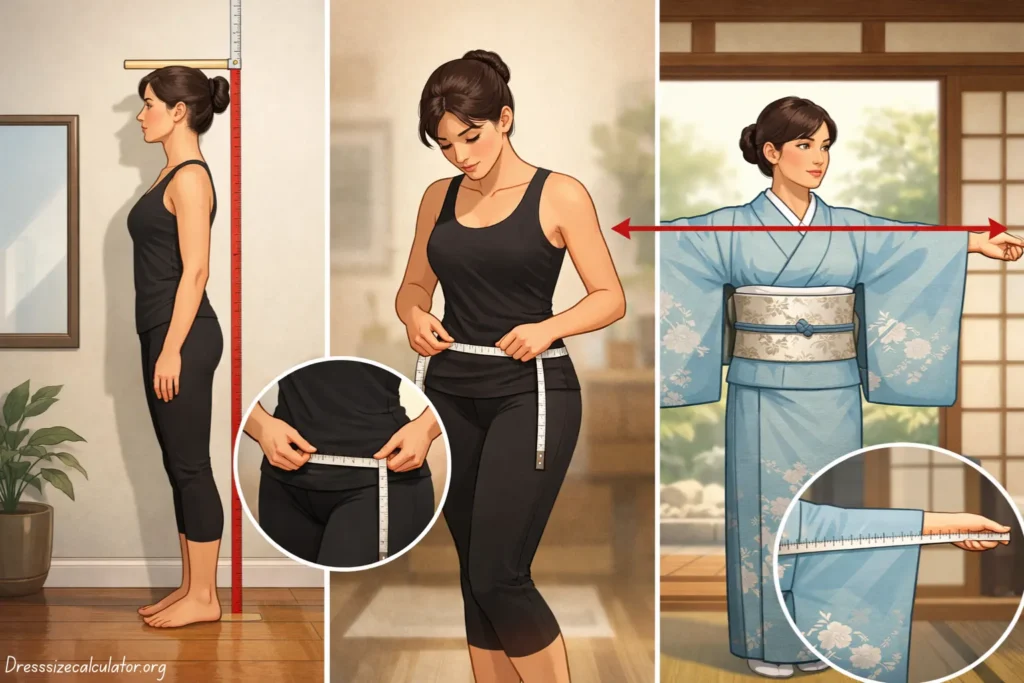
I measure my height barefoot from the floor to the top of my head. Then I measure around the widest part of my hips, because that determines how well the kimono will wrap around my body.
I also measure my arm span from shoulder to wrist, because sleeve length makes a surprisingly big difference in how elegant a kimono looks.
Once I have these numbers, I enter them into a Kimono Size Calculator instead of guessing or trusting “free size” labels.
Since I started doing this, I haven’t had a single sizing disaster with kimonos.
Why Kimono Sizes Vary So Much Between Brands
Another thing most people don’t realise is that kimono sizing is not standardised across all brands.
Some brands design for modern fashion wear. Some stick closely to traditional Japanese proportions.
Some assume the kimono will be worn casually, while others assume it will be worn formally with proper layering.
This is why one brand’s “medium” can feel completely different from another brand’s “medium.” This is also why relying only on size labels is a recipe for disappointment.
A calculator-based approach shifts your mindset from brand sizes to real measurements.
Instead of thinking “I’m a size M,” you start thinking “my height is 165 cm and my hips are 95 cm.” That one shift makes online kimono shopping far more accurate and far less stressful.
The Comfort and Confidence Factor Nobody Talks About
Here’s something people rarely mention when talking about kimonos: a well-fitted kimono changes how you feel about yourself.
When your kimono fits properly, you stand straighter. You move more gracefully.
You stop worrying about adjusting the fabric every two minutes. You actually enjoy wearing it instead of feeling self-conscious.
I’ve noticed this especially at cultural events and photoshoots. The people who look the best in kimonos are not always the tallest or the slimmest. They are the ones whose kimonos fit properly.
That’s why I always say that a Kimono Size Calculator is not just a sizing tool. It’s a confidence tool.
Why a Kimono Size Calculator Is Actually a Smart Tool
At first glance, a Kimono Size Calculator might sound unnecessary. After all, people have been wearing kimonos for centuries without calculators.
But the world has changed.
- We buy clothes online now.
- We don’t try them on before ordering.
- Returns are annoying and expensive.
- Size charts are confusing and inconsistent.
In this reality, a calculator that uses your real body measurements to suggest a kimono size is genuinely useful.
- It saves time.
- It reduces returns.
- It improves comfort.
- It makes cultural wear more accessible to everyone.
And once you use it a few times, you’ll wonder why you didn’t start earlier.
Final Thoughts – Respect the Tradition, Respect the Fit
A kimono is not just another outfit. It’s a piece of culture, craftsmanship, and history. It deserves to be worn properly.
If you’ve never worn a kimono before or if you’ve had a bad sizing experience in the past, don’t rely on guesswork again.
Take two minutes to measure yourself properly and use a Kimono Size Calculator to guide your choice.
It can save you money, embarrassment, and a lot of unnecessary discomfort.
And more importantly, it helps you wear your kimono the way it was meant to be worn: with grace, confidence, and perfect balance.
Disclaimer: Please note that the sizes provided by our Kimono Size Calculator may not perfectly match the sizing conventions of all clothing stores and brands.
Sizes can vary between manufacturers and collections, so we recommend using this tool as a guide and checking the specific size charts of the store or brand you are purchasing from for the most accurate fit.